Decoding Poker Hand Range Construction Techniques and Their Influence on Multi-Table Tournament Payout Structures
Written by Ines Berger · Jun 10, 2026
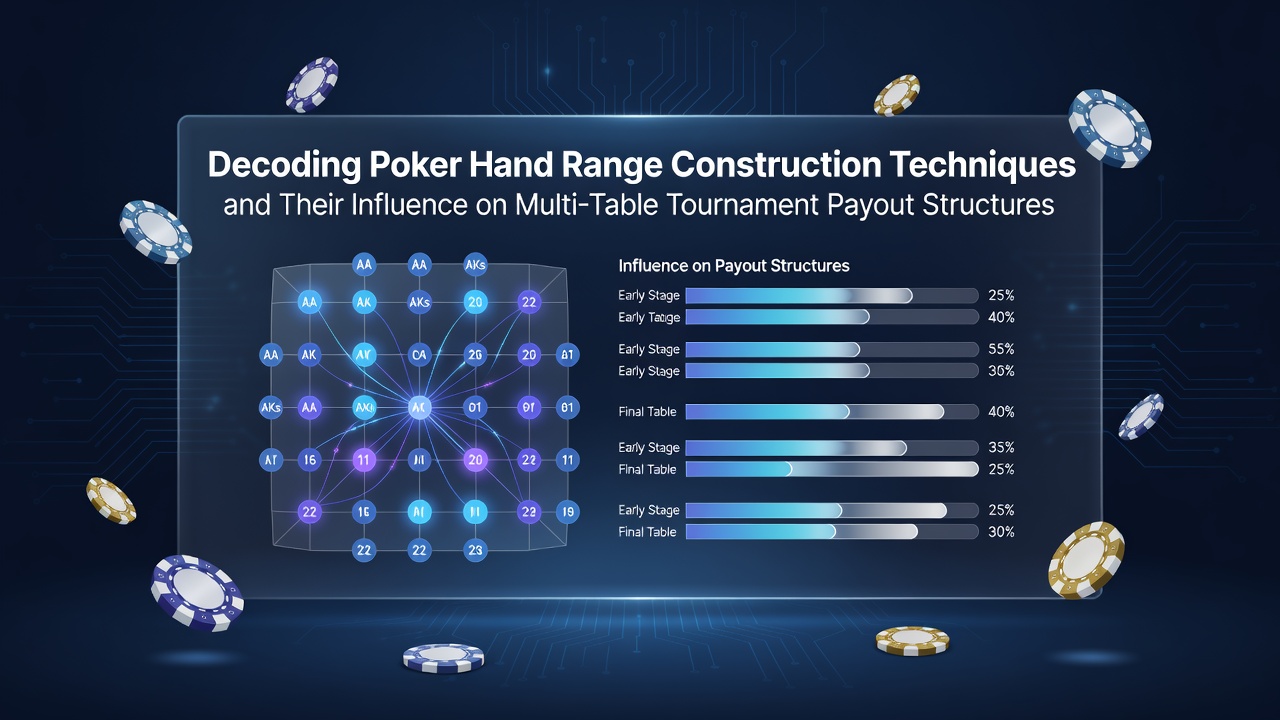
Decoding Poker Hand Range Construction Techniques and Their Influence on Multi-Table Tournament Payout Structures
Hand range construction forms the foundation of strategic decision-making in multi-table tournaments where players must balance immediate survival against long-term accumulation goals; observers note that effective ranges incorporate positional awareness, stack depths, and opponent tendencies while adapting dynamically as blinds increase and fields shrink. Data from major events shows that players who refine these ranges early often navigate pay jumps more consistently than those relying on static approaches, and recent figures from the 2026 World Series of Poker Circuit events highlight how such adjustments correlate with deeper runs.
Core Elements of Range Construction in Tournaments
Range building begins with preflop categories that expand or contract based on position, with early positions favoring tighter selections such as premium pairs and strong broadway hands while late positions allow wider combinations including suited connectors and small pairs. Stack size modulates these choices significantly because short stacks under 20 big blinds shift toward push-fold mathematics derived from independent chip model calculations, whereas deeper stacks permit more postflop playability considerations. Researchers have documented that incorporating blocker effects and removal cards further refines these ranges, allowing players to identify spots where certain holdings reduce opponents' continuing ranges.
Postflop range construction extends this framework through continuation betting frequencies, check-raising matrices, and river barreling decisions that align with perceived equity realization; experts observe that polarized ranges mixing value hands with bluffs maintain balance against observant opponents, while merged ranges prove effective in multiway pots common in early tournament stages. Those who study solver outputs recognize that real-time adjustments account for table dynamics and payout implications rather than fixed frequencies alone.
Adjusting Ranges for Payout Structure Variations
Multi-table tournament payout structures determine the marginal value of chips at different stages, directly shaping range widths because top-heavy distributions reward accumulation while flatter structures emphasize min-cash survival and incremental pay jumps. In events with 15 percent or fewer players paid, ranges tighten considerably near the money bubble as the cost of elimination rises sharply, yet the same players widen ranges once in the money when chasing larger payouts becomes viable. Industry reports indicate that structures paying 20 percent or more of the field encourage earlier risk-taking since more participants reach paid positions.

June 2026 saw several circuits implement hybrid structures blending guaranteed minimums with steeper top-end increments, and data collected from these events reveals measurable shifts in pre-bubble fold frequencies compared with prior seasons. Players facing steeper payout curves construct ranges that prioritize high-equity holdings capable of realizing value across multiple streets, whereas flatter distributions permit speculative hands that perform well in implied-odds scenarios.
ICM Integration and Real-Time Range Refinement
Independent chip model software integrates payout tables with stack distributions to output adjusted ranges that reflect the actual dollar value of survival versus elimination at each pay level. Tournament participants who consult these outputs during breaks often tighten opening ranges by 10 to 15 percent in high-variance spots near significant pay jumps, according to aggregated hand histories from major operators. Yet ICM pressure diminishes once a comfortable cushion above the next payout threshold is achieved, allowing ranges to revert toward chip-EV optimal widths.
Table composition further influences these refinements because shorter stacks behind exert folding pressure that widens calling ranges, while deeper stacks ahead compress three-bet ranges to maintain fold equity. Observers tracking 2026 festival results note that players who recalibrate ranges after each payout level reached maintain higher average stack sizes through final tables than those applying uniform strategies.
Case Examples from Recent Circuits
One documented final table from a June 2026 European series illustrated how a player with a 12-big-blind stack shifted to a polarized jam range consisting of the top 8 percent of hands plus suited wheel aces, precisely because teh payout structure awarded substantial jumps between fifth and third place. Another participant facing a flatter structure maintained wider defending ranges from the big blind throughout the money stages, capitalizing on frequent dead money from shorter stacks unwilling to risk elimination. These examples demonstrate how range construction directly responds to the specific payout matrix rather than applying universal templates.
Conclusion
Range construction techniques in multi-table tournaments evolve continuously as players incorporate payout data, stack dynamics, and positional factors into cohesive strategies that maximize expected value across varying structures. Evidence from recent circuits shows that those who treat ranges as fluid constructs rather than fixed lists achieve more consistent results through pay jumps and final tables alike, underscoring the interplay between mathematical modeling and live adaptation in today's competitive landscape.