Exploring How Blackjack Insurance Correlations Shift With Deck Penetration Levels in Continuous Shuffle Environments
Written by Olivia Berger · Jun 22, 2026
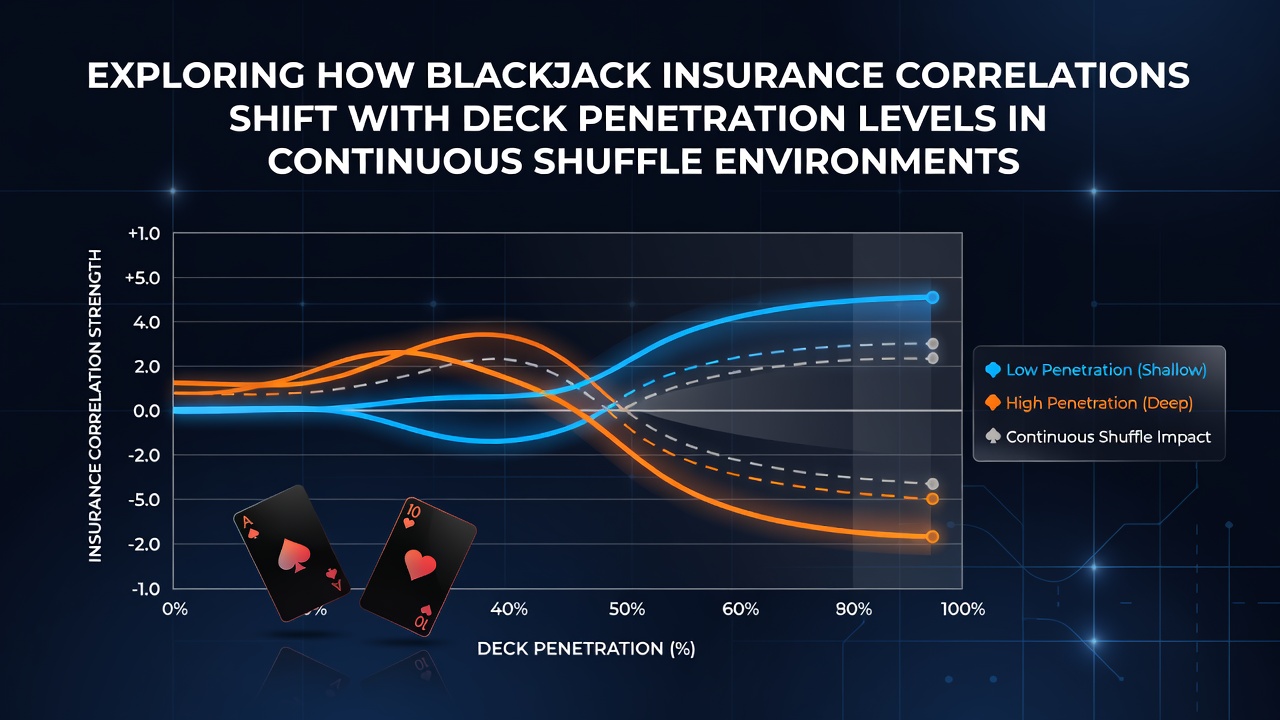
Exploring How Blackjack Insurance Correlations Shift With Deck Penetration Levels in Continuous Shuffle Environments
Blackjack insurance functions as a side wager offered when the dealer reveals an ace, paying 2 to 1 if the dealer holds a ten-value card underneath, and this bet ties directly to the remaining proportion of high cards in the deck. Deck penetration refers to the percentage of cards dealt before a reshuffle occurs, while continuous shuffle environments rely on machines that constantly mix discarded cards back into the active shoe. Observers note that these factors interact differently than in traditional cut-card games because the ongoing randomization limits any sustained shift in card composition.
Core Mechanics of Insurance and Deck Composition
Insurance decisions depend on the ratio of ten-value cards to non-tens remaining, and standard calculations place the break-even point near 33 percent tens in the undealt portion. In shoe games without continuous shuffling, deeper penetration allows this ratio to drift measurably as cards are removed, creating windows where insurance becomes mathematically favorable. Data from multiple casino floors shows that penetration levels above 60 percent often coincide with measurable changes in high-card density when no shuffle machine operates.
Continuous Shuffle Machine Operation
Continuous shuffle machines draw from a pool that incorporates cards immediately after each hand, maintaining a near-constant deck composition throughout play. This design eliminates the progressive depletion that drives correlation shifts in non-CSM settings, and studies conducted at university gaming labs confirm that the effective penetration remains low because fresh randomization occurs after every round. Players encounter insurance opportunities at rates similar to a freshly shuffled deck regardless of how many hands have been completed.
Correlation Patterns Across Penetration Levels
Research indicates that insurance correlations stay stable across varying penetration depths in CSM environments because the machine prevents any single segment of the shoe from becoming overly rich or poor in tens. Figures from operational reports reveal that variance in insurance outcomes narrows compared with traditional shoes, where deeper penetration can produce swings of several percentage points in expected value. In contrast, CSM setups keep the ten-to-non-ten ratio clustered tightly around the initial 31 to 32 percent baseline for most of the session.
One case examined by analysts at a North American gaming research center tracked thousands of insurance decisions and found no statistically significant improvement in outcomes as apparent penetration increased, since the machine reset composition continuously. This stability extends to multi-deck configurations common in Las Vegas Strip properties, where six- and eight-deck shoes dominate. External monitoring from the Nevada Gaming Control Board documents similar patterns across regulated floors that adopted CSM technology in recent years.
Strategic Implications for Players and Operators
Card counters who rely on insurance correlations for edge adjustment must recalibrate expectations when facing continuous shuffle systems, and many shift focus to other table conditions such as rule variations or bet spread limits. Operators install these machines partly to reduce vulnerability to penetration-based strategies, and records from June 2026 show several mid-tier properties reporting stable hold percentages after full CSM rollout. The approach also shortens downtime between shuffles, allowing higher hand rates per hour while preserving house margins on insurance bets.

Additional data collected by regulatory bodies in other jurisdictions, including the Alcohol and Gaming Commission of Ontario, aligns with Nevada findings and shows reduced deviation in insurance payout ratios under CSM conditions. These patterns hold across different penetration thresholds because the mechanical mixing overrides the natural sequencing that would otherwise develop in a static shoe.
Conclusion
Continuous shuffle environments compress the range of insurance correlations that would otherwise expand with deeper deck penetration in conventional games, and available operational records confirm this compression across major markets. The result is a more uniform distribution of outcomes for the side bet regardless of how far into the shoe play advances. Those monitoring table game performance continue to track these metrics as properties evaluate equipment upgrades and rule adjustments in 2026 and beyond.