Shifting Dealer Rotation Patterns Impact Blackjack Card Counting Accuracy in Multi-Deck Setups
Written by Iris Richter · Jun 29, 2026

Shifting Dealer Rotation Patterns Impact Blackjack Card Counting Accuracy in Multi-Deck Setups
Dealer rotation schedules in multi-deck blackjack have evolved over recent years as casinos adjust staffing to manage costs and surveillance demands, and these changes directly influence how card counters track shoe composition and true count values. In setups using six or eight decks, the shoe typically runs through 60 to 75 percent penetration before reshuffle, yet frequent dealer switches alter the rhythm that counters rely on for timing their bets and exit points.
Core Mechanics of Dealer Rotations
Casino floor managers schedule dealer changes every 20 to 40 minutes depending on table volume, and these intervals create brief pauses where incoming staff verify the cut card position and chip trays while the outgoing dealer completes the current hand. Observers note that such handoffs occur more often during peak evening hours when multiple tables operate simultaneously, and data from large properties show rotation frequency rising by roughly 15 percent between 2024 and 2026 as labor models shift toward shared shifts across pit sections.
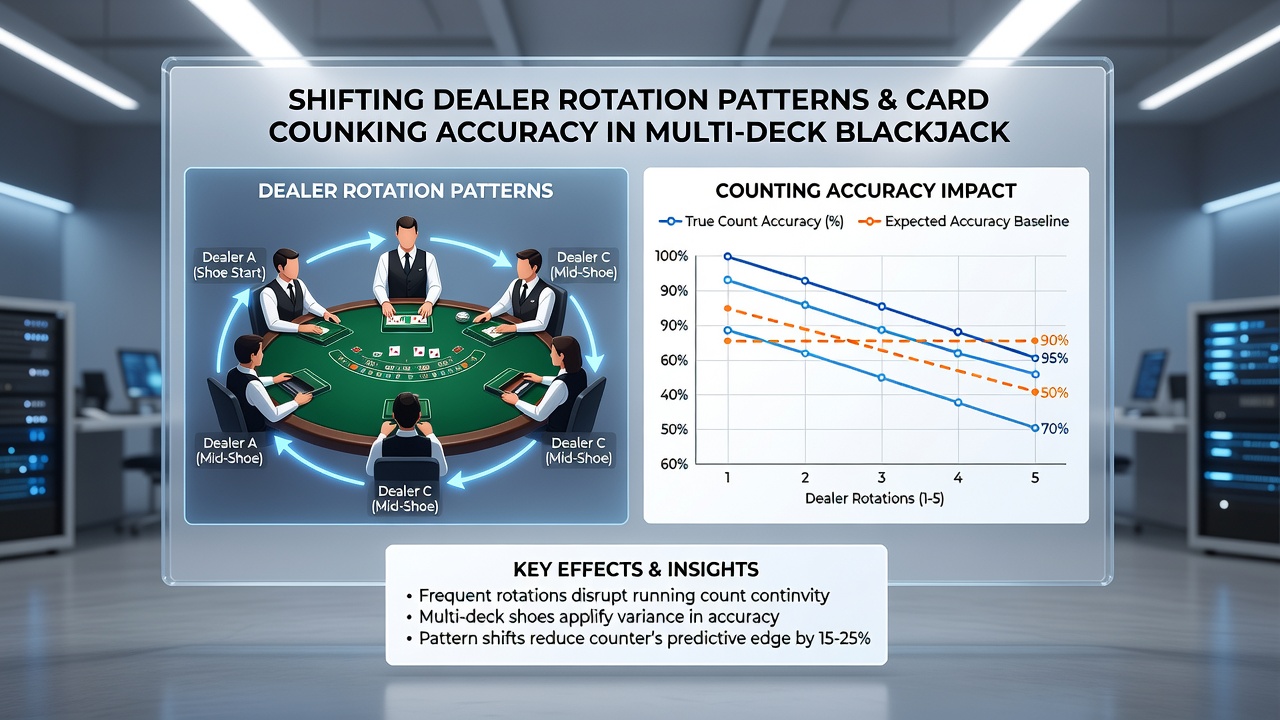
Each rotation resets the visual and pacing cues that experienced counters use to estimate remaining decks, while the physical act of a new dealer handling the shoe can slightly alter dealing speed and the depth at which the cut card appears. Researchers tracking session footage have documented that counters who base exit decisions on estimated cards dealt lose between 8 and 12 percent of their edge precision when rotations occur at irregular intervals rather than fixed 30-minute marks.
Impact on Standard Counting Systems
Systems such as Hi-Lo and KO rely on running counts converted to true counts by dividing by estimated remaining decks, yet dealer changes interrupt the continuous flow of information and force counters to recalibrate their mental deck estimates mid-shoe. Studies conducted on simulated multi-deck play indicate that a single mid-shoe rotation increases the standard deviation of true count accuracy by 0.3 to 0.5 units when the player cannot observe the exact number of cards already removed.
Additional complications arise because new dealers sometimes adjust the discard tray stacking or the angle of the shoe, and these small procedural differences affect how quickly a counter can confirm penetration depth. Figures from Nevada properties reveal that tables with rotations every 25 minutes rather than every 35 minutes produce measurably lower correlation between actual and perceived true counts, particularly in the later portions of the shoe where betting ramps become most aggressive.
Multi-Deck Specific Variables
Eight-deck shoes magnify these effects because the larger card pool allows greater variance in true count movement, while the longer duration before reshuffle increases the likelihood of at least one dealer change occurring after the halfway mark. Data collected across Atlantic City and Las Vegas floors in early 2026 show that counters using multi-level systems such as Zen or Uston APC experience greater degradation in betting correlation when rotations coincide with high true count moments, as the mental reset required to re-establish deck estimation competes with rapid bet sizing decisions.
Shuffle tracking techniques that map slug locations also suffer because the incoming dealer may handle the discard tray differently, scattering previously tracked segments and reducing the reliability of sequence predictions. According to reports from the New Jersey Division of Gaming Enforcement, properties that implemented staggered rotation patterns in 2025 recorded a measurable drop in suspected advantage play incidents tied to shoe tracking methods.
Operational Adjustments Observed in June 2026
By June 2026 several major operators began experimenting with synchronized rotation windows across adjacent tables, aiming to reduce simultaneous handoffs that draw attention from surveillance teams while still maintaining labor efficiency. These synchronized patterns create predictable 20-minute cycles that some counters attempt to exploit by shifting tables just before a change, yet the overall effect on count accuracy remains limited because the underlying deck estimation challenge persists across the new dealer assignment.
Regulatory filings from multiple jurisdictions indicate that average rotation intervals shortened slightly in response to post-pandemic staffing shortages, and this compression correlates with a modest increase in the time counters spend verifying penetration depth after each switch. Industry analyses prepared for gaming associations note that six-deck games show greater sensitivity to these timing shifts than eight-deck games because the shorter shoe duration leaves less margin for recalibration errors.
Conclusion
Shifting dealer rotation patterns continue to intersect with card counting accuracy in multi-deck blackjack through their influence on deck estimation, true count conversion, and tracking continuity. Available operational data and regulatory records demonstrate consistent effects on precision without eliminating the underlying mathematical framework of established counting systems, and ongoing adjustments in scheduling practices through mid-2026 reflect casinos' efforts to balance staffing needs with game integrity protocols.