The Interplay of Side Bet Payout Structures and Table Minimum Adjustments Across Regional Craps Venues
Written by Eden Simon · Jun 24, 2026
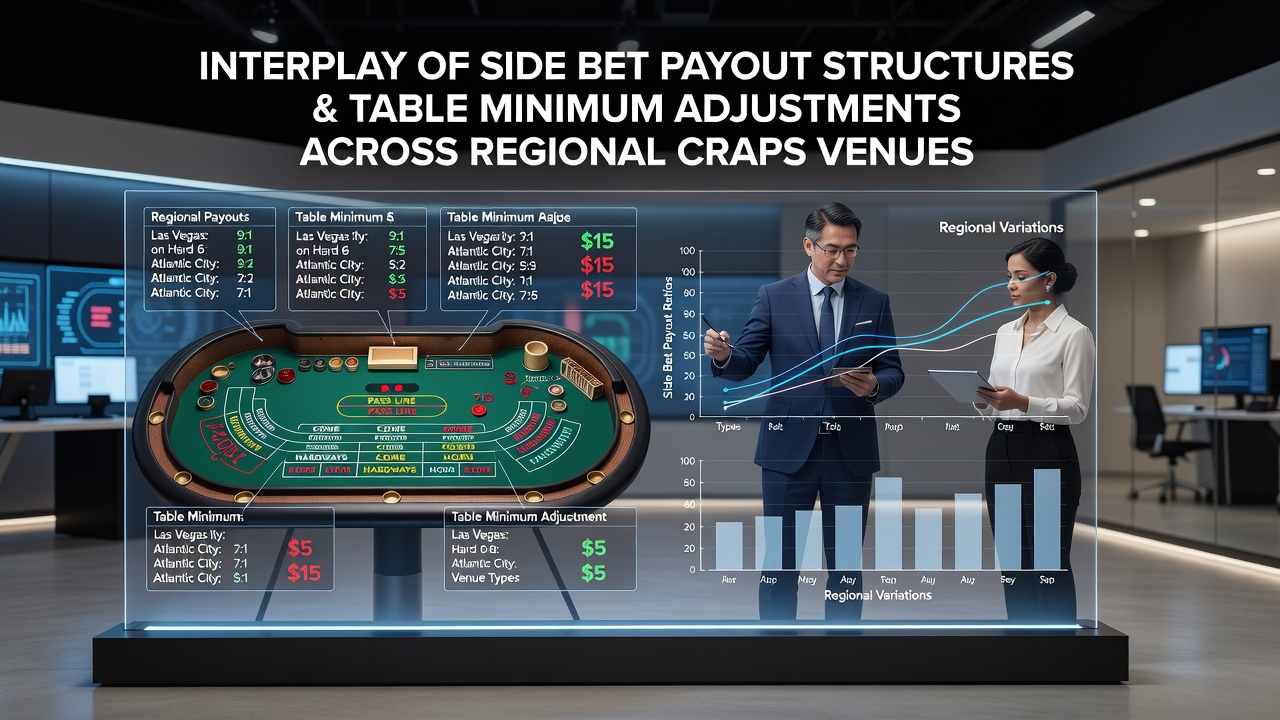
The Interplay of Side Bet Payout Structures and Table Minimum Adjustments Across Regional Craps Venues
Regional craps venues adjust side bet payout structures and table minimums in coordinated ways that respond to player volume, regulatory requirements, and operational costs. Side bets such as the field, any seven, and hardways carry fixed payout ratios that range from 1:1 on even-money wagers to 30:1 or higher on low-probability propositions, while table minimums set the entry point for all wagers including those side options. Operators track how these two elements interact because higher side bet payouts often coincide with elevated minimums that filter participation levels across different markets.
Core Mechanics of Side Bet Payouts in Craps
Side bet payouts follow standardized ratios that vary by jurisdiction and house policy. The field bet typically pays 1:1 on 3, 4, 9, 10, and 11 while doubling on 2 and 12 in many venues, though some properties shift the 2 and 12 payouts to 3:1 to alter volatility. Proposition bets like any seven sit at 4:1, hard six and hard eight at 9:1, and hard four and hard ten at 7:1, with these figures remaining consistent yet subject to promotional tweaks during slow periods. Data from state gaming reports shows that these ratios directly influence average bet size because players often layer side wagers onto base pass line bets when minimums permit smaller increments.
Table Minimum Adjustments by Region
Table minimums differ sharply across regions because local competition, tourism patterns, and regulatory oversight shape pricing decisions. Las Vegas Strip properties commonly post minimums between $15 and $25 during peak hours while downtown venues hold $10 tables that attract higher side bet volume. Atlantic City casinos set minimums from $10 to $15 with occasional $5 promotions, whereas Midwestern tribal casinos frequently maintain $5 and $10 tables year-round to sustain foot traffic. Observers note that when side bet payouts increase on select propositions, minimums rise in tandem to offset the added payout exposure and maintain house edge stability.
How Payout Structures Drive Minimum Changes
Venues monitor side bet participation rates to decide when minimum adjustments become necessary. Elevated payouts on hardways or any craps increase the theoretical house edge variance, prompting operators to raise minimums from $10 to $15 or higher so that base bets absorb more of the action. In June 2026 several properties in Pennsylvania and New Jersey implemented simultaneous payout reductions on select side bets alongside minimum increases of $5, a move documented in monthly gaming revenue filings. This linkage occurs because side bets contribute disproportionately to total handle during low-minimum sessions, and operators recalibrate both variables to stabilize daily win percentages.

Regional differences appear most clearly when comparing payout tables side by side. Mississippi riverboat casinos keep many side bets at standard ratios yet post lower minimums than coastal properties, while California card rooms that offer craps variants cap certain proposition payouts and maintain higher minimums to align with local compact terms. Those who've examined multi-state data sets find that a 1:1 field bet paired with a $25 minimum produces different session lengths than the same bet at a $10 table, because players adjust their side bet frequency based on the total bankroll required to stay active.
Regulatory and Market Influences on Adjustments
State gaming control boards require operators to file payout schedule changes in advance, which creates predictable windows when minimums also shift. Nevada filings from early 2026 show multiple venues altering both side bet odds and minimums within the same reporting period, often citing competitive pressure from neighboring properties. Tribal regulators in Oklahoma and Florida apply similar oversight, requiring public notice when payout structures on hardways or field bets change. These filings reveal that minimum increases frequently follow payout expansions because regulators and operators both track the combined impact on player bankroll requirements and house revenue consistency.
Examples from Specific Venues
One Las Vegas downtown property reduced its any seven payout from 4:1 to 3:1 while lifting the table minimum from $10 to $15, resulting in measurable shifts in side bet handle according to internal floor reports. A tribal casino in Michigan maintained standard hardway payouts yet raised minimums seasonally from $5 to $10, correlating with a drop in proposition bet frequency that operators attributed to the higher entry cost. Atlantic City venues experimented with 2:1 field payouts on both 2 and 12 during promotional weeks, then reverted minimums upward once the promotion ended, illustrating the temporary nature of many paired adjustments.
Trends Observed Through Mid-2026
Through June 2026, data compiled by state agencies indicates that properties with higher side bet payout variety tend to sustain elevated minimums longer than venues with standard offerings. This pattern holds across both high-traffic tourist markets and regional day-trip destinations. Operators continue to test combinations where modest payout improvements on low-volatility side bets allow minimums to remain accessible, while high-volatility propositions stay paired with stricter minimum thresholds. Such strategies appear in operational summaries submitted to gaming commissions and reflect ongoing calibration between risk exposure and player accessibility.
Conclusion
Side bet payout structures and table minimum adjustments function as interconnected levers that regional craps venues tune in response to local conditions and regulatory frameworks. The documented interplay shows that changes to one element routinely accompany shifts in the other, producing consistent patterns across markets from the Las Vegas Strip to tribal properties in multiple states. Continued monitoring of state filings and operational reports will track how these relationships evolve in subsequent periods.