Tracing Multi-Deck Penetration Rates and Basic Strategy Deviations in Extended Blackjack Play at Destination Resorts
Written by Ines Berger · Jul 31, 2026

Tracing Multi-Deck Penetration Rates and Basic Strategy Deviations in Extended Blackjack Play at Destination Resorts
Multi-deck blackjack games at destination resorts rely on penetration rates that determine how far dealers deal into the shoe before reshuffling occurs, and these rates directly influence when players apply basic strategy deviations based on running or true counts. Penetration typically ranges from 50 to 80 percent of the total decks in play, with higher figures allowing more cards to be observed and counted before the cut card appears. Observers note that this depth affects the reliability of count-based decisions because deeper penetration produces more accurate true count calculations in multi-deck formats.
Penetration Mechanics in Resort Settings
Destination resorts in major gaming markets often use six- or eight-deck shoes where the dealer inserts a cut card at a predetermined depth, and the actual penetration achieved depends on house policy and regulatory oversight from bodies such as the Nevada Gaming Control Board. Higher penetration means the shoe lasts longer between shuffles, which extends the window during which card counters can track remaining high and low cards. Data from industry reports shows that resorts adjust penetration to balance game speed against house advantage, with figures above 75 percent increasing volatility for both players and operators.
Basic strategy charts provide the foundation for all decisions, yet deviations emerge when the true count reaches specific thresholds listed in resources like the Illustrious 18. For example, a player might stand on 16 against a dealer ten only when the true count exceeds a certain positive value, and that threshold shifts slightly as more decks remain unseen. Extended sessions compound this effect because fatigue and table pace alter how accurately players maintain the count while the shoe depletes.
How Penetration Alters Deviation Timing
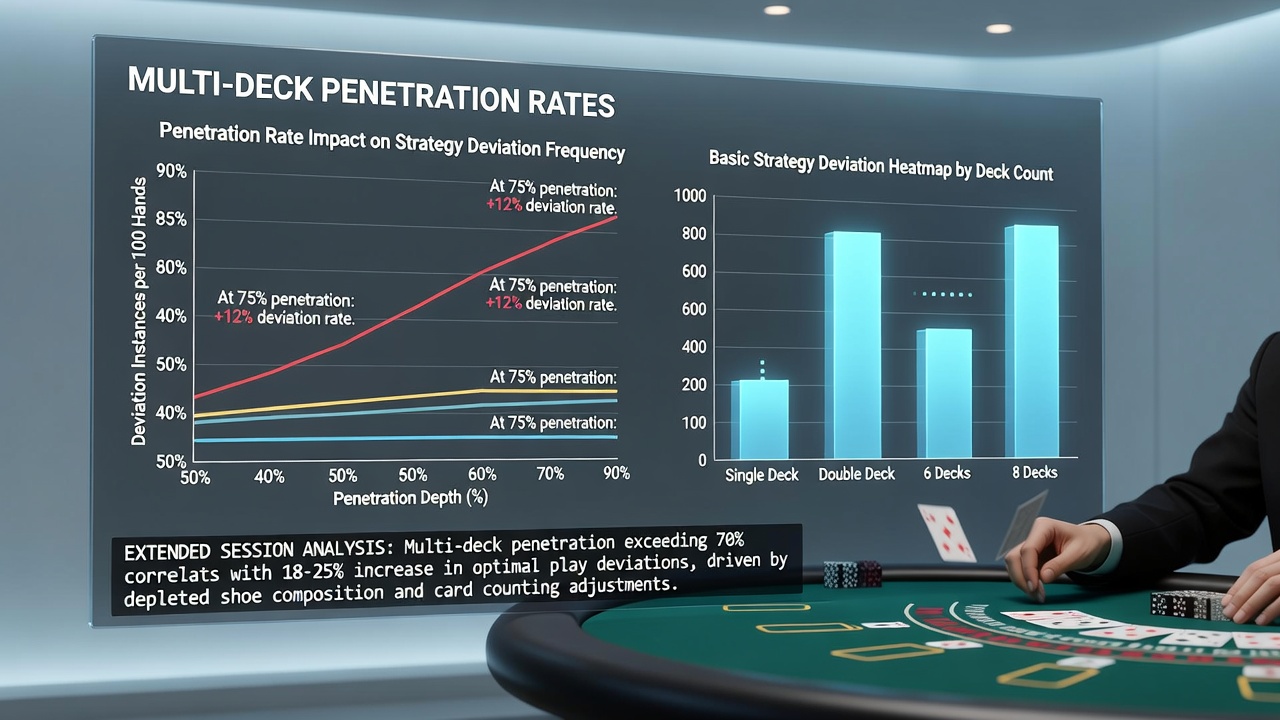
Lower penetration forces earlier shuffles, which resets the count more frequently and reduces opportunities for deviations that require deep shoe data. In contrast, resorts maintaining 75 percent or greater penetration allow the count to climb or drop further before the cut card stops play, so players encounter more instances where insurance bets, double-down adjustments, and surrender decisions become favorable at lower true count values than standard charts suggest. Researchers tracking session data at properties in Nevada and Atlantic City have documented that deviation frequency rises measurably once penetration exceeds 70 percent in eight-deck games.
During multi-hour sessions the cumulative effect becomes noticeable because each dealt round removes cards that would otherwise dilute the true count. A running count that appears neutral at the start of a shoe can produce actionable deviations by the fourth or fifth deck when penetration permits continued play. Those who study these patterns find that surrender deviations, such as surrendering 15 against a dealer ten, activate at progressively lower true counts as the remaining deck fraction shrinks.
Session Length and Count Accuracy
Extended play at destination resorts introduces additional variables because table minimums, comp structures, and crowd levels influence how long individual shoes remain in use. Higher penetration supports longer shoes, which in turn lets the true count stabilize around more extreme values and triggers deviations that would not appear in shallow-cut games. Figures from the New Jersey Division of Gaming Enforcement indicate that average hands per shoe increase when penetration deepens, giving counters more decisions per shuffle cycle.
Players who maintain accurate counts across these longer sequences notice that certain index plays, such as doubling 10 against a dealer nine, move into positive expectation territory earlier in the shoe than basic strategy alone predicts. Yet the same depth also magnifies any counting errors because more cards contribute to the final true count calculation. Academic papers on blackjack mathematics published by researchers at the University of Nevada, Las Vegas demonstrate that variance in outcome widens with deeper penetration even when the same set of deviations is applied.
Resort-Specific Rule Interactions
Many destination properties combine multi-deck penetration policies with rules such as double after split or surrender availability, and these combinations modify the exact true count values at which deviations become profitable. Resorts in Macau and Singapore markets, regulated under frameworks from the Gaming Inspection and Coordination Bureau, often use similar penetration depths but apply different side bets that interact with count-based decisions. Observers tracking cross-regional data note that deviation charts require recalibration whenever house rules or penetration percentages change.
During peak summer periods, including the lead-up to events scheduled for July 2026, resort floor traffic can shorten effective session lengths even when penetration remains high because more players join tables and slow the deal pace. This dynamic reduces the number of hands observed per shoe and thereby limits the depth at which extreme true counts develop.
Conclusion
Penetration rates in multi-deck blackjack games at destination resorts shape the frequency and timing of basic strategy deviations by controlling how deeply the count can develop before reshuffles occur. Higher penetration extends the value of count information across more hands, while lower rates reset the information window more often. Data from regulatory agencies and academic studies continues to map these relationships, showing that session length, rule variations, and regional oversight all interact with penetration to determine when players apply index plays during extended resort visits.